- Made this
- 0 crocheters
- Skill level
- Intermediate
- Yarn weight
- Worsted
- Hook size
- 5 mm
- Finished size
- 12.5" x 12.5" (32 x 32 cm), about 1.75 to 2.25 hours each.
On this page
- Skill level
Intermediate
Comfortable with shaping, joining and reading counts.
- Use
12.5" x 12.5" (32 x 32 cm), about 1.75 to 2.25 hours each.
About this pattern
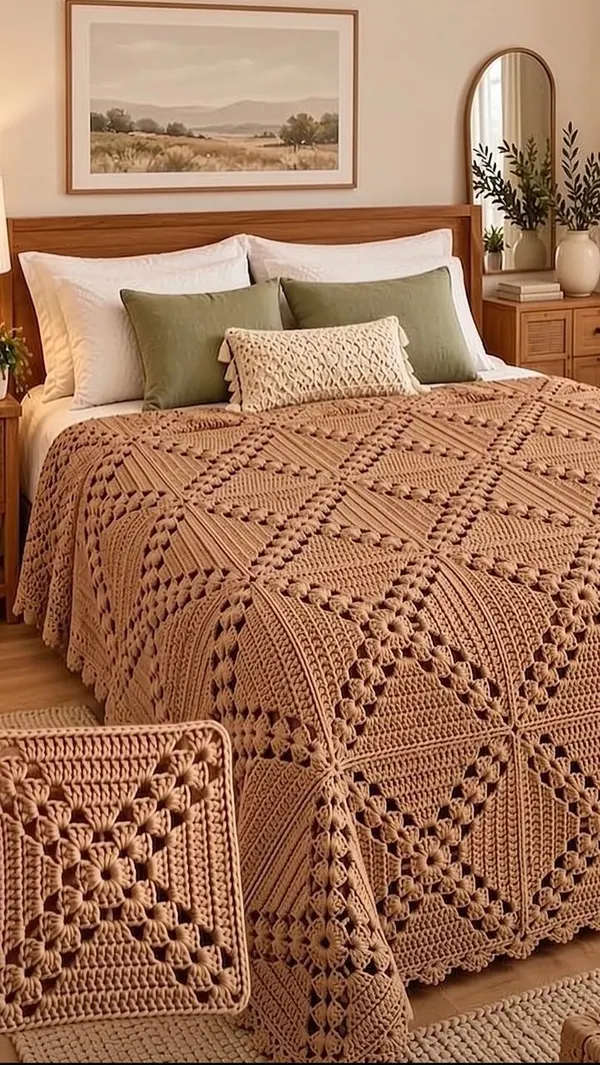
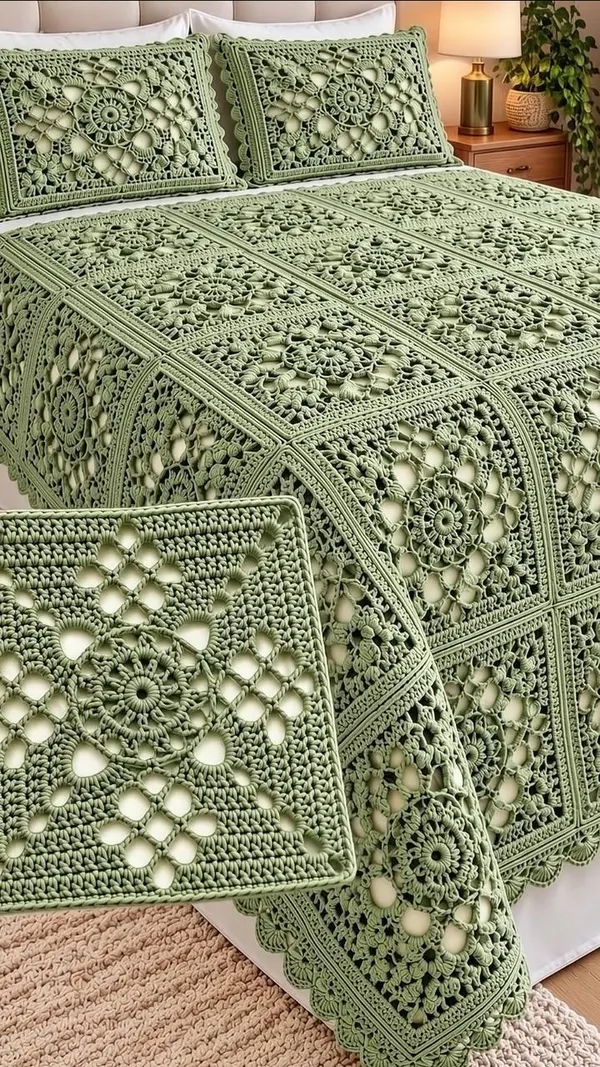
This crochet lace bedspread pattern is a modern take on the heirloom coverlets our grandmothers treasured. Each large square opens with a wheel-and-cluster medallion, then grows four lacy diamonds that frame it like a window. Worked in a single soft sage, the squares join with raised ridges so the whole bed looks quilted in lace. It's a slow, soothing project with very few ends to weave in. Make a throw, a full bedspread or matching Euro shams, and you'll have a gift worth passing down.
Skill level: Intermediate. You'll work clusters, chain loops and simple filet-style lace in the round. The stitches are easy, but the lace rounds need careful counting.
Common mistakes & how to fix them
- Keep the medallion flat
- If Rnds 3 to 5 ruffle, your chains are too loose; work them a little tighter or go down half a hook size for those rounds only. If the medallion cups, loosen your chains. A flat medallion is the key to a square that blocks neatly.
- Mark the middle of each side
- Before each lace round, place a marker in the middle stitch of each side. The holes should always be centered on that marker. If they drift, you've miscounted, and it's much easier to fix one round than to rip back three.
- Make the ridge seams even
- Join all squares with the RS facing the same way so every ridge sits on the front. Keep your sc tension the same as in the squares; a tight join pulls the bedspread in, while a loose one waves. Joining with a hook half a size larger than your main hook often helps.
Materials needed
Yarn
- Yarn: light sage, pistachio or celadonWorsted weight · One square: 110 yd (100 m)
Tools
- Crochet hook: 5.0 mm (US H-8).
- Tapestry (yarn) needle
- 4 stitch markers (to mark corners)
- Scissors
- Measuring tape
- Blocking mats and plenty of rust-proof pins (lace needs pinning to open up)
- 26" x 26" (66 x 66 cm) Euro pillow insert, for the sham
Gauge & finished measurements
Gauge: Gauge matters, because every square has to match for a flat, even join. 14 dc and 8 rows = 4" (10 cm) with a 5.0 mm hook. Quick check: After Rnd 6, the square measures about 5" (12.5 cm) from side to side. Finished square: 12.5" x 12.5" (32 cm) after Rnd 13 and blocking.
| One square | 12.5" x 12.5" (32 x 32 cm), about 1.75 to 2.25 hours each. |
|---|---|
| Throw | Layout: 4 x 5 · Finished size (with border): 52" x 64" (132 x 163 cm) · Squares: 20 · Estimated time: 40 to 50 hours |
| Twin coverlet | Layout: 6 x 8 · Finished size (with border): 77" x 102" (196 x 259 cm) · Squares: 48 · Estimated time: 90 to 115 hours |
| Queen coverlet | Layout: 8 x 8 · Finished size (with border): 102" x 102" (259 x 259 cm) · Squares: 64 · Estimated time: 120 to 150 hours |
| Euro sham (each) | 2 x 2 front + 2 x 2 back · 26" x 26" (66 x 66 cm) · 8 · 16 to 20 hours |
Row counter
Row 0
Tap the circle after each row
The pattern
The medallion
Work in rounds with the RS facing you; don't turn. Stitch counts in brackets are the total for the round. Count each lace hole (ch-2) as 2 sts.
Squaring round
Lace diamond rounds
From here, each round starts and ends the same way:
Info: A diamond of holes grows in the middle of each side: 1 hole, then 3, then 5, then 3, then 1.
Joining edge
Block the squares
Lace only looks its best after blocking. Pin each square to 12.5" x 12.5", pinning out every lace hole and chain loop so the diamonds open up (see Care Instructions). Let the squares dry completely before joining.
Join with raised ridges
The photo-style bedspread has neat raised lines between squares. To get them:
Info: The sc seam sits on top as a soft ridge on the RS. For a flatter join, whip stitch through back loops instead.
Scalloped border
Info: The shells need a count of 4 per repeat plus 1 on each side. Some sizes need 2 or 3 extra sc: work 2 sc instead of 1 at that many seams, spread out along the side. Use this table (N = squares along the side):
Info: Squares along side (N): 2 (Euro sham) · Seams with 2 sc: 1 (work 3 sc there) · Rnd 1 sts per side: 93 · Shells per side: 23
Info: Squares along side (N): 4 · Seams with 2 sc: 0 · Rnd 1 sts per side: 181 · Shells per side: 45
Info: Squares along side (N): 5 · Seams with 2 sc: 3 · Rnd 1 sts per side: 229 · Shells per side: 57
Info: Squares along side (N): 6 · Seams with 2 sc: 2 · Rnd 1 sts per side: 273 · Shells per side: 68
Info: Squares along side (N): 8 · Seams with 2 sc: 0 · Rnd 1 sts per side: 361 · Shells per side: 90
Info: Each count includes the corner sc at both ends of the side.
Matching Euro sham (fits 26" x 26" / 66 x 66 cm)
Important notes
- Tip: Amounts include joining and border. Buy about 10% extra, all from one dye lot. A single-color lace bedspread shows any shade difference.
- Tip: Abbreviations (US terms): MR = magic ring, ch = chain, sl st = slip stitch, sc = single crochet, hdc = half double crochet, dc = double crochet, tr = treble crochet, cl = 3-dc cluster (see below), beg cl = beginning cluster (see below), st(s) = stitch(es), sp(s) = space(s), sk = skip, beg = beginning, rep = repeat, Rnd(s) = round(s), RS / WS = right side / wrong side.
- Tip: 3-dc cluster (cl): *Yo, insert hook in sp, pull up a loop, yo and draw through 2 loops; rep from * 2 more times in the same sp. Yo and draw through all 4 loops.
- Tip: Beginning cluster (beg cl): Ch 2, then work a 2-dc cluster in the same sp (*yo, insert, pull up a loop, yo and draw through 2; rep from * once more, yo and draw through all 3 loops). It looks like a full cluster.
- Tip: Lace hole: "Ch 2, sk next 2 sts, dc in next st" makes one open square in the lace diamonds.
- Tip: Counting over holes: A ch-2 sp from the round below counts as 2 sts. When an instruction says "dc in next X sts" and you reach a ch-2 sp, work 2 dc into the sp. When it says "sk next 2 sts" over a ch-2 sp, skip the whole sp.
- Tip: Washing: Follow your yarn label first. For acrylic or acrylic-cotton blends, machine wash cold on a delicate cycle inside a large mesh bag or zipped pillowcase, so the lace doesn't snag. Use mild detergent and no bleach.
- Tip: Drying: Roll the bedspread in towels to press out water, then lay it flat over a bed or several drying racks. Gently stretch it back to shape and smooth the lace diamonds open with your fingers. Never hang lace wet; the weight will pull it long.
- Tip: Blocking squares: Cotton or cotton blend: Soak each square in cool water for 15 minutes, squeeze gently and roll in a towel. Pin to 12.5" x 12.5", placing extra pins in the chain loops and lace holes, and let dry completely. Acrylic: Pin dry squares to size, then hover a steamer about 1" above them without touching. Let cool and dry before unpinning. Steam relaxes acrylic lace permanently, so go gently.
- Tip: Storage: Fold loosely with acid-free tissue between layers and store in a breathable cotton bag, away from sunlight, to keep the sage color fresh.
- Tip: Yarn: Worsted weight (#4 Medium) in light sage, pistachio or celadon. A smooth acrylic-cotton blend gives crisp lace and easy washing; 100% cotton shows the lace beautifully but makes a heavier bedspread. Avoid fuzzy or textured yarns, which hide the holes.
- Tip: Yarn amounts: One square: 110 yd (100 m); Throw: 2,400 yd (2,195 m), about 12 skeins of 200 yd; Twin coverlet: 5,700 yd (5,210 m), about 29 skeins; Queen coverlet: 7,600 yd (6,950 m), about 38 skeins; Euro sham (each): 1,000 yd (915 m), about 5 skeins.
- Tip: Gauge: Square too big? Go down a hook size. Too small? Go up one. Lace grows a little when blocked, so always measure after blocking.
Pattern FAQ
What yarn is best for a crochet lace bedspread?
A smooth, plied cotton or acrylic-cotton blend shows lace holes clearly and keeps its shape after blocking. Worsted weight gives a cozy, modern bedspread; for a finer vintage look, use DK or sport weight with a smaller hook and make more squares.
How many squares do I need for a queen size bedspread?
With 12.5" squares, an 8 x 8 layout (64 squares) makes about 102" x 102" with the border, which drapes over the sides of a queen bed. For a coverlet that sits on top, 6 x 7 (42 squares) is enough.
Why does my lace granny square curl or ruffle?
Curling or cupping usually means your chains or corners are too tight. Ruffling means the chains are too loose or there are extra stitches. Check your counts each round, adjust your chain tension, and remember that blocking fixes small waves but not wrong counts.
Do I need to block a crochet lace blanket?
Yes. Blocking opens up the lace holes, evens out the stitches and makes every square the same size, which makes joining much easier. Block the squares before joining, then give the finished bedspread a light refresh.
Ratings & reviews
No reviews yet. Made it? Be the first to share how it went.
I made this!
Finished your Sage Lace Medallion? Share a photo and it may be featured in our Made-by-You gallery.
Sage Lace Medallion: Free Crochet Lace Bedspread Pattern (Vintage-Style Squares), © 2026 Mandy’s Crochet Studio. Source: https://mandyshealthylife.com/patterns/sage-lace-medallion-free-crochet-lace-bedspread-pattern-vintage-style-squares/. Please do not redistribute this pattern.